Resources
Guides & File Prep
File formats, tolerances, and prep guides to get your project print-ready. Details coming soon.
Sending files
get it ready, get it to us
The easiest way to get us files or start up a new project request is through our online request form. If you have a custom portal, discuss transfer details with your salesperson.
File Size limits
Upload limit via our online portal is 300mb per individual file. Multiple files may be included in a single submission. Files that exceed that limit may be shared via link from a hosting service of your choice (dropbox, wetransfer, google drive, etc).
file types
We accept a range of standard and native file formats. Speak with your salesperson about any specific filetypes not listed below. Access may vary.
Mesh:
CAD:
STL, OBJ, FBX
3MF, STEP, IGES
NATIVE Applications
Each of our technicians may us a number of software as part of their workflow but each of the below software represents a regular fixture of our workflow.
Software:
Rhino, Materialise Magics, Zbrush, Blender, Fusion 360, Artec 3D, and more…
No file? No Problem
Reach out about design or consulting services, while including as many starting details as possible. Images, Sketches, Scripts and Mood Boards can all be applicable…
Sending files
get it ready, get it to us
The easiest way to get us files or start up a new project request is through our online request form. If you have a custom portal, discuss transfer details with your salesperson.
File Size limits
Upload limit via our online portal is 300mb per individual file. Multiple files may be included in a single submission. Files that exceed that limit may be shared via link from a hosting service of your choice (dropbox, wetransfer, google drive, etc).
file types
We accept a range of standard and native file formats. Speak with your salesperson about any specific filetypes not listed below. Access may vary.
Mesh:
CAD:
STL, OBJ, FBX
3MF, STEP, IGES
NATIVE Applications
Each of our technicians may us a number of software as part of their workflow but each of the below software represents a regular fixture of our workflow.
Software:
Rhino, Materialise Magics, Zbrush, Blender, Fusion 360, Artec 3D, and more…
No file? No Problem
Reach out about design or consulting services, while including as many starting details as possible. Images, Sketches, Scripts and Mood Boards can all be applicable…
Sending files
get it ready, get it to us
The easiest way to get us files or start up a new project request is through our online request form. If you have a custom portal, discuss transfer details with your salesperson.
File Size limits
Upload limit via our online portal is 300mb per individual file. Multiple files may be included in a single submission. Files that exceed that limit may be shared via link from a hosting service of your choice (dropbox, wetransfer, google drive, etc).
file types
We accept a range of standard and native file formats. Speak with your salesperson about any specific filetypes not listed below. Access may vary.
Mesh:
CAD:
STL, OBJ, FBX
3MF, STEP, IGES
NATIVE Applications
Each of our technicians may us a number of software as part of their workflow but each of the below software represents a regular fixture of our workflow.
Software:
Rhino, Materialise Magics, Zbrush, Blender, Fusion 360, Artec 3D, and more…
No file? No Problem
Reach out about design or consulting services, while including as many starting details as possible. Images, Sketches, Scripts and Mood Boards can all be applicable…
SLA
SLA GUIDELINES
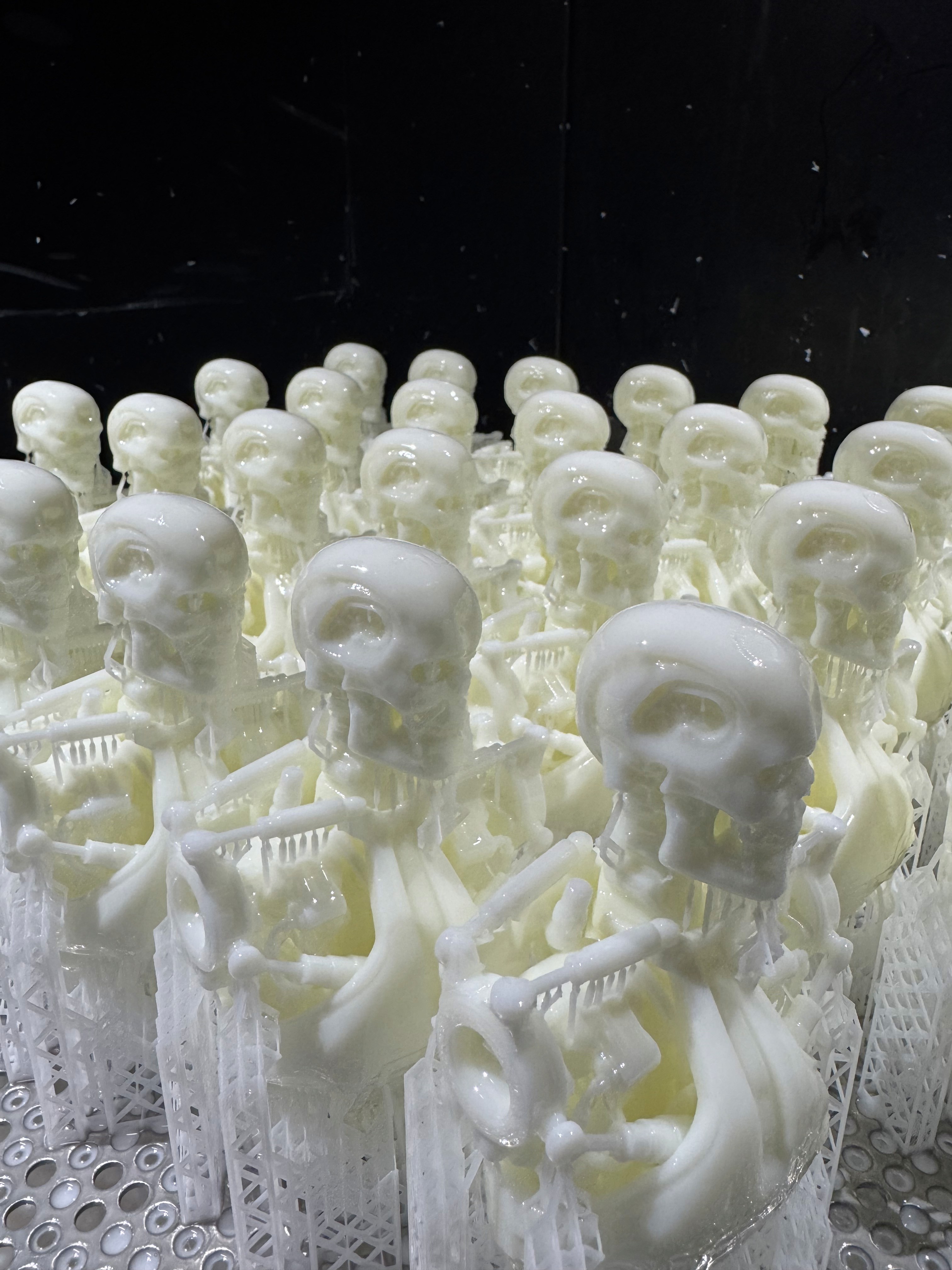
Our resin-based 3D Prints can feature incredible levels of detail across industrial-scale parts. Some things to keep in mind as you prep projects targeting SLA Production.
surface area drives cost
SLA Production at scale typically involves hollowing parts to economize material use (and production expense). Our standard wall thickness for hollowed SLA parts is between 2.5-3.5mm.
As a result, parts with complex outer surfaces can see much different material costs than a volumetrically similar counterpart. See the below sample of a disc an gear that occupy the same space, but see drastically different material use along the outer edge.

Walls, Fine Features, and Processing
SLA Resin is fragile when produced on thin or detailed features and can be prone to break if not accounted for correctly.
TYHI recommends the following part minimum thicknesses to ensure successful production, cleanup and processing.
Defining Walls:
Tapered Point lengths:
Minimum Wall:
2mm
15mm
0.6mm

transparent vs clear
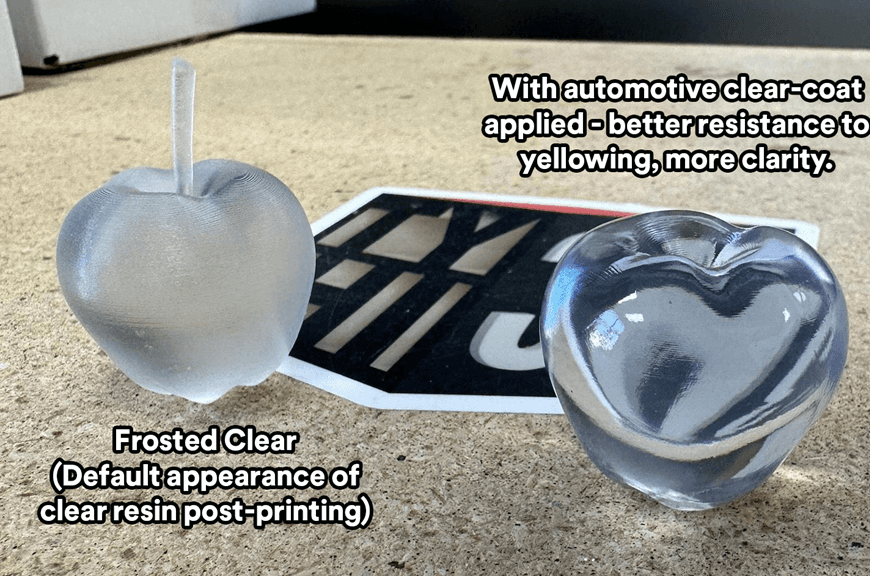
Our transparent resin requires additional post-processing and refinishing to achieve optical clarity. Objects with interior cavities, like bottles, where that interior is difficult to access may not be deliverable as clear items. Check with your salesperson.
tolerances
These are minimum tolerances we use internally when preparing interfacing SLA Prints. The values can be plugged in for any value for c, d, and e in the chart below if considering assembly or production.
Joining Surfaces :
Interfacing Surfaces:
Paint Clearances:
Plating Clearances:
0.3mm
0.7mm
0.6mm
1mm (minimum)

Request a quote
SLA
SLA GUIDELINES
Our resin-based 3D Prints can feature incredible levels of detail across industrial-scale parts. Some things to keep in mind as you prep projects targeting SLA Production.
surface area drives cost
SLA Production at scale typically involves hollowing parts to economize material use (and production expense). Our standard wall thickness for hollowed SLA parts is between 2.5-3.5mm.
As a result, parts with complex outer surfaces can see much different material costs than a volumetrically similar counterpart. See the below sample of a disc an gear that occupy the same space, but see drastically different material use along the outer edge.
Walls, Fine Features, and Processing
SLA Resin is fragile when produced on thin or detailed features and can be prone to break if not accounted for correctly.
TYHI recommends the following part minimum thicknesses to ensure successful production, cleanup and processing.
Defining Walls:
Tapered Point lengths:
Minimum Wall:
2mm
15mm
0.6mm
transparent vs clear
Our transparent resin requires additional post-processing and refinishing to achieve optical clarity. Objects with interior cavities, like bottles, where that interior is difficult to access may not be deliverable as clear items. Check with your salesperson.
tolerances
These are minimum tolerances we use internally when preparing interfacing SLA Prints. The values can be plugged in for any value for c, d, and e in the chart below if considering assembly or production.
Joining Surfaces :
Interfacing Surfaces:
Paint Clearances:
Plating Clearances:
0.3mm
0.7mm
0.6mm
1mm (minimum)
Request a quote
SLA
SLA GUIDELINES
Our resin-based 3D Prints can feature incredible levels of detail across industrial-scale parts. Some things to keep in mind as you prep projects targeting SLA Production.
surface area drives cost
SLA Production at scale typically involves hollowing parts to economize material use (and production expense). Our standard wall thickness for hollowed SLA parts is between 2.5-3.5mm.
As a result, parts with complex outer surfaces can see much different material costs than a volumetrically similar counterpart. See the below sample of a disc an gear that occupy the same space, but see drastically different material use along the outer edge.
Walls, Fine Features, and Processing
SLA Resin is fragile when produced on thin or detailed features and can be prone to break if not accounted for correctly.
TYHI recommends the following part minimum thicknesses to ensure successful production, cleanup and processing.
Defining Walls:
Tapered Point lengths:
Minimum Wall:
2mm
15mm
0.6mm
transparent vs clear
Our transparent resin requires additional post-processing and refinishing to achieve optical clarity. Objects with interior cavities, like bottles, where that interior is difficult to access may not be deliverable as clear items. Check with your salesperson.
tolerances
These are minimum tolerances we use internally when preparing interfacing SLA Prints. The values can be plugged in for any value for c, d, and e in the chart below if considering assembly or production.
Joining Surfaces :
Interfacing Surfaces:
Paint Clearances:
Plating Clearances:
0.3mm
0.7mm
0.6mm
1mm (minimum)
Request a quote
MJF
MJF GUIDELINES
Durable, functional, powder-based nylon prints allow for limitless geometries and print-in-place mechanics.
See the downloadable Best Practices guides from HP for complete details.

Algorithmic Pricing
MJF costs are driven by part size and batch unit economy. Large, awkward shapes that don't allow multiple parts as part of production bear the brunt of production expenses. While small, nesting parts get produced at scale with aggressive discounts.

Walls, Fine Features, and Processing
SLA Resin is fragile when produced on thin or detailed features and can be prone to break if not accounted for correctly.
TYHI recommends the following part minimum thicknesses to ensure successful production, cleanup and processing.
Defining Walls:
Tapered Point lengths:
Minimum Wall:
2mm
30mm
0.5mm

Surface finish & Vapor Smoothing
Powder-based nylon production produces parts with incredible accuracy, but is known for a slightly textured surface finish that is similar to a fine grit sandpaper. Because of the durability of nylon prints, parts are often best prepped for finishing with a surface primer. The parts themselves to do not sand well.
The addition of vapor smoothing can increase both the quality of finish and ductility of parts, but can cause small features of details below 1.5mm to distort or melt entirely.
tolerances
These are minimum tolerances we use internally when preparing interfacing MJF Prints. The values can be plugged in for any value for c, d, and e in the chart below if considering assembly or production.
Joining Surfaces :
Interfacing Surfaces:
Paint Clearances:
Plating Clearances:
0.35mm
0.7mm
0.8mm
1.5mm (minimum)
Request a quote
MJF
MJF GUIDELINES
Durable, functional, powder-based nylon prints allow for limitless geometries and print-in-place mechanics.
See the downloadable Best Practices guides from HP for complete details.
Algorithmic Pricing
MJF costs are driven by part size and batch unit economy. Large, awkward shapes that don't allow multiple parts as part of production bear the brunt of production expenses. While small, nesting parts get produced at scale with aggressive discounts.
Walls, Fine Features, and Processing
SLA Resin is fragile when produced on thin or detailed features and can be prone to break if not accounted for correctly.
TYHI recommends the following part minimum thicknesses to ensure successful production, cleanup and processing.
Defining Walls:
Tapered Point lengths:
Minimum Wall:
2mm
30mm
0.5mm
Surface finish & Vapor Smoothing
Powder-based nylon production produces parts with incredible accuracy, but is known for a slightly textured surface finish that is similar to a fine grit sandpaper. Because of the durability of nylon prints, parts are often best prepped for finishing with a surface primer. The parts themselves to do not sand well.
The addition of vapor smoothing can increase both the quality of finish and ductility of parts, but can cause small features of details below 1.5mm to distort or melt entirely.
tolerances
These are minimum tolerances we use internally when preparing interfacing MJF Prints. The values can be plugged in for any value for c, d, and e in the chart below if considering assembly or production.
Joining Surfaces :
Interfacing Surfaces:
Paint Clearances:
Plating Clearances:
0.35mm
0.7mm
0.8mm
1.5mm (minimum)
Request a quote
MJF
MJF GUIDELINES
Durable, functional, powder-based nylon prints allow for limitless geometries and print-in-place mechanics.
See the downloadable Best Practices guides from HP for complete details.
Algorithmic Pricing
MJF costs are driven by part size and batch unit economy. Large, awkward shapes that don't allow multiple parts as part of production bear the brunt of production expenses. While small, nesting parts get produced at scale with aggressive discounts.
Walls, Fine Features, and Processing
SLA Resin is fragile when produced on thin or detailed features and can be prone to break if not accounted for correctly.
TYHI recommends the following part minimum thicknesses to ensure successful production, cleanup and processing.
Defining Walls:
Tapered Point lengths:
Minimum Wall:
2mm
30mm
0.5mm
Surface finish & Vapor Smoothing
Powder-based nylon production produces parts with incredible accuracy, but is known for a slightly textured surface finish that is similar to a fine grit sandpaper. Because of the durability of nylon prints, parts are often best prepped for finishing with a surface primer. The parts themselves to do not sand well.
The addition of vapor smoothing can increase both the quality of finish and ductility of parts, but can cause small features of details below 1.5mm to distort or melt entirely.
tolerances
These are minimum tolerances we use internally when preparing interfacing MJF Prints. The values can be plugged in for any value for c, d, and e in the chart below if considering assembly or production.
Joining Surfaces :
Interfacing Surfaces:
Paint Clearances:
Plating Clearances:
0.35mm
0.7mm
0.8mm
1.5mm (minimum)
Request a quote
FILAMENT
FDM GUIDELINES
Tried and true Filament 3D Printing, for simple, functional parts where surface finish is not a leading requirement.

Walls, Fine Features, and Processing
Filament prints are durable with thin, connected, surfaces that maintain robust levels of strength.
Minimum Feature:
1.4mm

tolerances
These are minimum tolerances we use internally when preparing interfacing FDM Prints. The values can be plugged in for any value for c, d, and e in the chart below if considering assembly or production.
Joining Surfaces :
Interfacing Surfaces:
Paint Clearances:
Plating Clearances:
0.35mm
0.7mm
0.8mm
1.5mm (minimum)
Request a quote
FILAMENT
FDM GUIDELINES
Tried and true Filament 3D Printing, for simple, functional parts where surface finish is not a leading requirement.
Walls, Fine Features, and Processing
Filament prints are durable with thin, connected, surfaces that maintain robust levels of strength.
Minimum Feature:
1.4mm
tolerances
These are minimum tolerances we use internally when preparing interfacing FDM Prints. The values can be plugged in for any value for c, d, and e in the chart below if considering assembly or production.
Joining Surfaces :
Interfacing Surfaces:
Paint Clearances:
Plating Clearances:
0.35mm
0.7mm
0.8mm
1.5mm (minimum)
Request a quote
FILAMENT
FDM GUIDELINES
Tried and true Filament 3D Printing, for simple, functional parts where surface finish is not a leading requirement.
Walls, Fine Features, and Processing
Filament prints are durable with thin, connected, surfaces that maintain robust levels of strength.
Minimum Feature:
1.4mm
tolerances
These are minimum tolerances we use internally when preparing interfacing FDM Prints. The values can be plugged in for any value for c, d, and e in the chart below if considering assembly or production.
Joining Surfaces :
Interfacing Surfaces:
Paint Clearances:
Plating Clearances:
0.35mm
0.7mm
0.8mm
1.5mm (minimum)
Request a quote
LET’S Print
Got more questions?
Reach out and one of our technicians will be happy to help guide you to the best process for your project.
Contact our team