Transform Your Ride with 3D Printed Car Parts
Discover how 3D printed car parts make customization easy and affordable. Learn about materials, benefits, and creating unique car designs!

Are you tired of driving a car that looks just like everyone else's? Do you know that over 90% of cars on the road today are mass-produced, with little to no customization? It's time to stand out from the crowd and make your ride truly yours with 3D-printed car parts and accessories.
3D printing technology is revolutionizing the automotive industry, allowing car enthusiasts to create unique, personalized parts that were once impossible or prohibitively expensive to produce.
In this article, you'll discover:
-
The benefits of using 3D printing for car customization
-
The types of parts and accessories you can 3D print
-
How to get started with designing and printing your own custom car parts with the help of There You Have It 3D Printing
Get ready to transform your vehicle into a one-of-a-kind masterpiece that reflects your personal style and turns heads wherever you go.
Benefits of 3D Printing for Car Customizatio
3D printing technology offers numerous advantages for car enthusiasts looking to customize their vehicles with unique parts and accessories. Here are the key benefits:
- Cost-effectiveness
- 3D printing is often more affordable than traditional manufacturing methods, especially for small-batch or one-off production.
- It eliminates the need for expensive tooling and molds, reducing upfront costs.
- Rapid prototyping and faster production times
- 3D printing allows for quick iteration and testing of designs, enabling faster product development.
- Parts can be printed on-demand, reducing lead times and inventory requirements.
- Design freedom and customization
- 3D printing enables the creation of intricate designs and complex geometries that would be difficult or impossible with traditional manufacturing methods.
- It offers nearly unlimited possibilities for personalization and customization to suit individual preferences.
- Lightweight and durable materials
- 3D printing materials, such as plastics and metals, can be both lightweight and strong, offering excellent performance for car parts.
- The table below compares the properties of common 3D printing materials used in automotive applications:
| Material | Strength | Weight | Heat Resistance | UV Resistance |
|---|---|---|---|---|
| PLA | Medium | Low | Low | Low |
| ABS | High | Medium | Medium | Medium |
| Nylon | High | Low | High | High |
| Carbon Fiber | Very High | Low | High | High |
| Aluminum | Very High | Medium | High | High |
| Titanium | Very High | Low | Very High | High |
By leveraging these benefits, car enthusiasts can create custom parts that enhance the performance, style, and functionality of their vehicles while saving time and money compared to traditional manufacturing methods.
Types of 3D-Printed Car Parts and Accessories
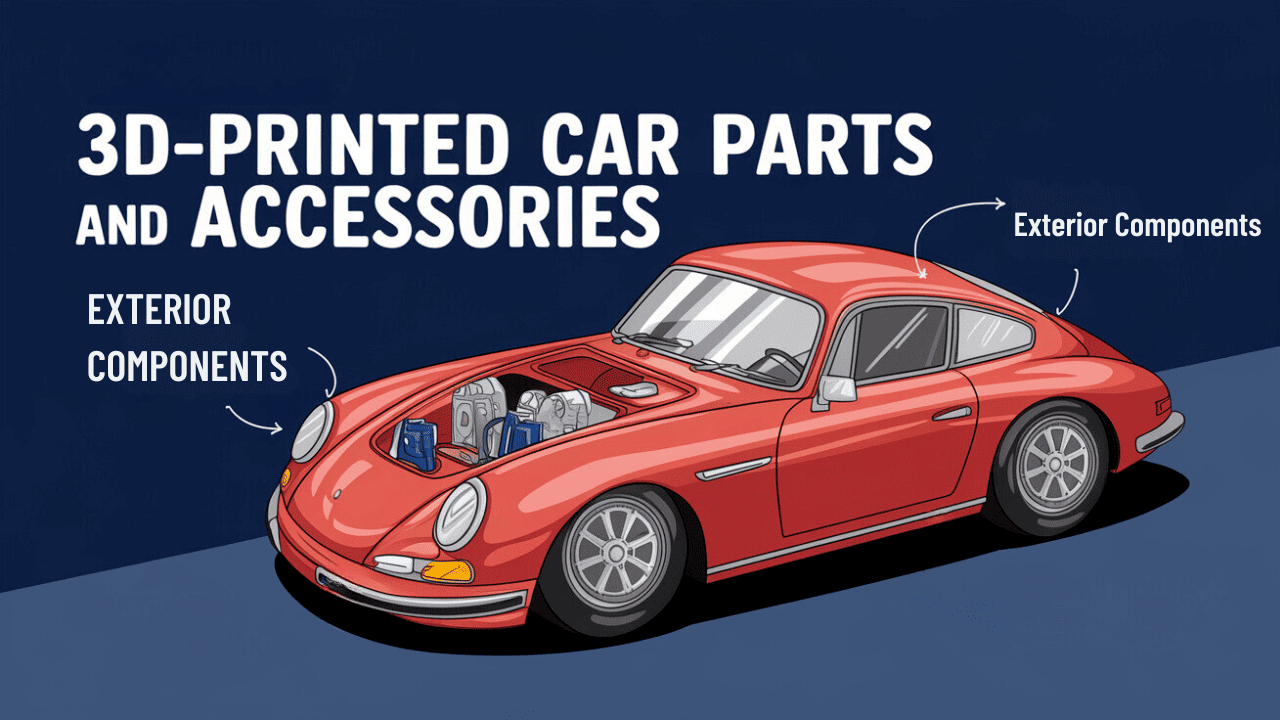
3D printing technology can be used to create a wide variety of car parts and accessories, both for aesthetic and functional purposes. Here are the main categories
- Exterior components
- Bumpers and bumper covers
- Spoilers and wings
- Grilles and mesh inserts
- Fenders and wide body kits
- Side skirts and splitters
- Mirror covers and caps
- Interior components
- Dashboard parts and trim pieces
- Knobs, buttons, and switches
- Center console accessories
- Door handles and panel inserts
- Shift knobs and boot covers
- Custom air vents and duct covers
- Functional parts
- Brackets and mounts
- Intake manifolds and plenums
- Cooling ducts and vents
- Sensor housings and covers
- Wiring loom clips and guides
- Custom engine bay accessories
- Wheels and wheel accessories
- Center caps and hub covers
- Lug nuts and wheel spacers
- Brake caliper covers
- Aerodynamic wheel covers
- Custom valve stem caps
The table below showcases some popular 3D-printed car parts and a list of their common materials:
| Part Category | Example Parts | Common Materials |
|---|---|---|
| Exterior | Bumpers, spoilers, grilles | ABS, PLA, nylon, carbon fiber |
| Interior | Dashboard trim, knobs, vents | PLA, ABS, nylon |
| Functional | Brackets, intake manifolds, ducts | Nylon, carbon fiber, aluminum |
| Wheels | Center caps, lug nuts, spacers | ABS, nylon, titanium |
These 3D-printed parts and accessories offer car enthusiasts endless possibilities for customization, allowing them to create unique designs that reflect their personal style and enhance the performance of their vehicles.
Materials Used in 3D Printing Car Parts
3D printing offers a wide range of material suitable for creating car parts and accessories. Each material has its own advantages and limitations, making it essential to choose the right one for your specific application. Here are the main categories of materials used in 3D printing car parts:
- Plastics
- PLA (Polylactic Acid): Biodegradable, easy to print, and suitable for interior parts and accessories.
- ABS Filament (Acrylonitrile Butadiene Styrene): Strong, durable, and heat-resistant, ideal for exterior and functional components.
- Nylon: Tough, flexible, and resistant to chemicals and abrasion, perfect for functional parts and accessories.
- Carbon Fiber Reinforced Plastics: Extremely strong and lightweight, used for high-performance and structural components.
- Metals
- Aluminum: Lightweight, strong, and heat-resistant, suitable for functional parts and wheels.
- Titanium: Exceptionally strong, lightweight, and corrosion-resistant, ideal for high-performance applications.
- Stainless Steel: Durable, corrosion-resistant, and suitable for functional parts and accessories.
The table below compares the properties of common 3D printing materials used in automotive applications:
| Material | Strength | Flexibility | Heat Resistance | UV Resistance | Common Applications |
|---|---|---|---|---|---|
| PLA | Medium | Low | Low | Low | Interior parts, accessories |
| ABS | High | Medium | Medium | Medium | Exterior parts, functional components |
| Nylon | High | High | High | High | Functional parts, brackets, ducts |
| Carbon Fiber | Very High | Low | High | High | Structural components, high-performance parts |
| Aluminum | Very High | Low | High | High | Functional parts, wheels, brackets |
| Titanium | Very High | Low | Very High | High | High-performance parts, structural components |
When selecting materials for 3D printing car parts, consider factors such as the part's intended use, required strength and durability, exposure to various temperatures, heat and UV light, and the desired aesthetics. By choosing the right material for your application, you can ensure that your 3D-printed car parts and accessories perform optimally and meet your specific needs.
How to Get Started with 3D Printing Car Parts
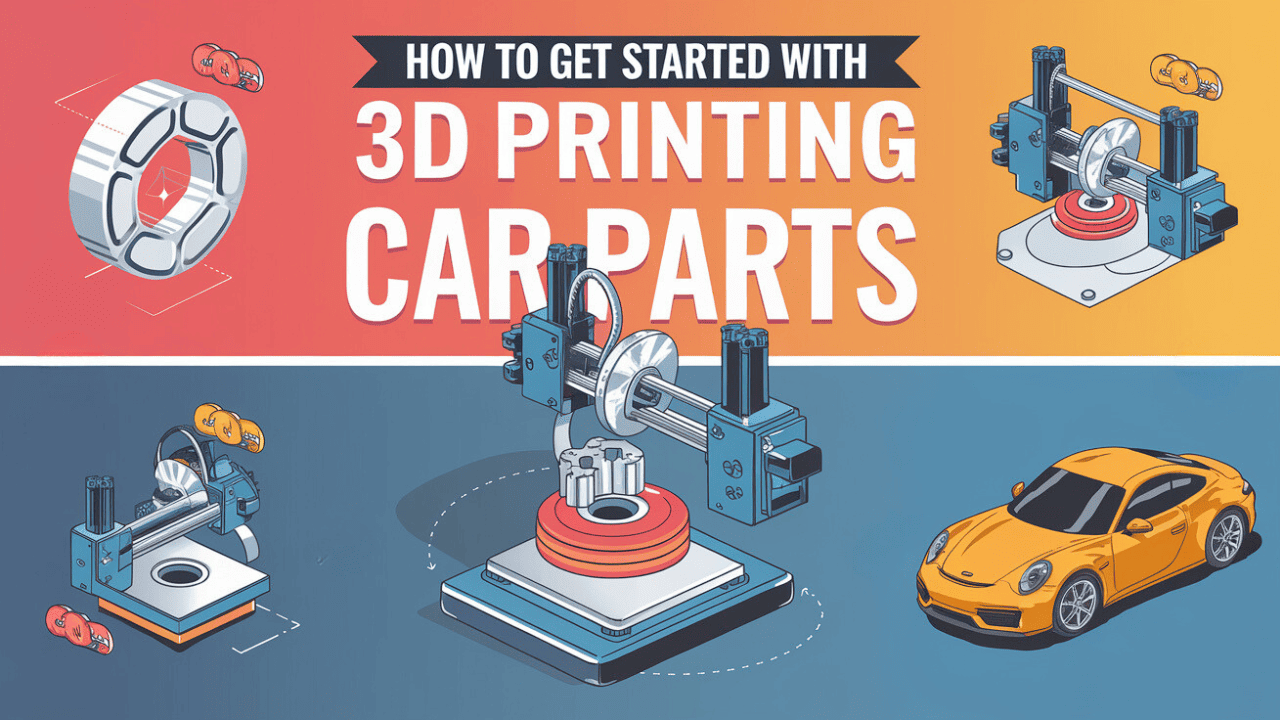
Getting started with 3D printing car parts is an exciting and rewarding process. Here's a step-by-step guide to help you begin your journey:
- Design your parts
- Use CAD (Computer-Aided Design) software to create 3D models of your desired car parts.
- Popular CAD software options include:
- AutoCAD
- SolidWorks
- Fusion 360
- SketchUp
- Alternatively, you can download pre-made designs from online repositories like Thingiverse or GrabCAD.
- Choose the right 3D printer and materials
- Select a 3D printer that meets your needs in terms of build volume, precision, and material compatibility.
- Consider the following factors when choosing a printer:
| Factor | Description |
|---|---|
| Build Volume | Ensure the printer can accommodate the size of your car parts. |
| Precision | Look for a printer with high resolution and accuracy for detailed parts. |
| Material Compatibility | Choose a printer that supports the materials you plan to use. |
- Select the appropriate material for your car parts based on strength, durability, and heat resistance requirements.
- Prepare your 3D printer files for printing
- Export your 3D models in a compatible file format, such as STL or OBJ.
- Use slicer software to generate G-code, which contains instructions for the 3D printer.
- Popular slicer software options include:
- Cura
- Slic3r
- Simplify3D
- Adjust print settings, such as layer height, infill density, and support structures, to optimize print quality and strength.
- Print and post-process your parts
- Load the chosen material into your 3D printer and begin the printing process.
- Monitor the print progress and make adjustments as needed.
- Once the print is complete, remove any support structures and clean up the part.
- Perform post-processing techniques, such as sanding, painting, or vapor smoothing, to improve the appearance and functionality of your parts.
- Test and refine your designs
- Install the 3D-printed parts on your car and test their fit and performance.
- Make note of any necessary adjustments or improvements to your designs.
- Iterate on your designs and repeat the 3D printing process until you achieve the desired results.
By following these steps and experimenting with different designs and materials, you'll be well on your way to creating custom 3D-printed car parts that enhance the performance and style of your vehicle.
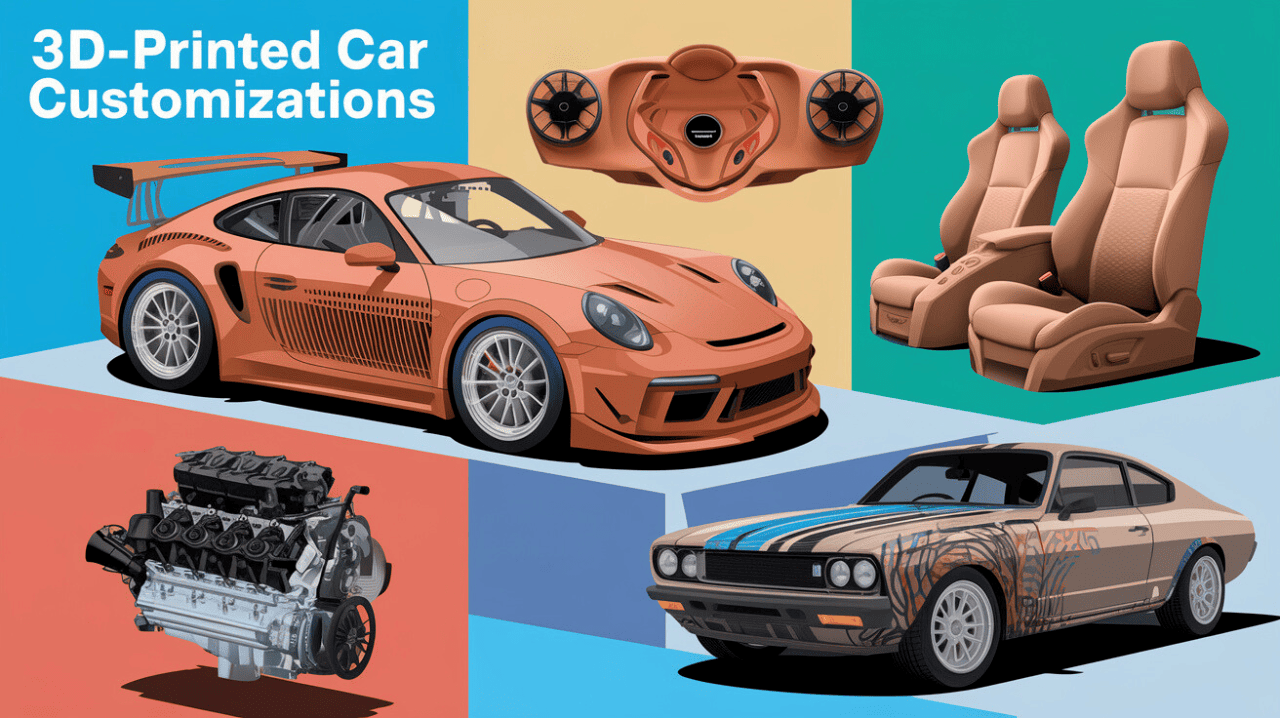
Examples of 3D-Printed Car Customizations
3D printing technology has opened up a world of possibilities for car enthusiasts looking to customize their vehicles. Here are some inspiring examples of 3D-printed car customizations:
- Custom body kits and aerodynamic enhancements
- Unique front and rear bumpers
- Aggressive side skirts and splitters
- Functional hood vents and scoops
- Rear spoilers and wings for improved downforce
- Personalized interior accessories and trim pieces
- Custom dashboard inserts and gauge surrounds
- Tailored door handles and panel covers
- Unique shift knobs and boot covers
- Personalized seat inserts and headrest covers
- Performance upgrades using 3D-printed parts
- High-flow intake manifolds and plenums
- Lightweight brackets and mounts for engine components
- Optimized cooling ducts and vents for radiators and brakes
- Custom turbocharger and supercharger housings
- Unique one-off designs and artistic elements
- Eye-catching grilles and mesh inserts
- Sculptural hood ornaments and emblems
- Artistic wheel center caps and lug nut covers
- Personalized license plate frames and holders
The table below showcases some notable examples of 3D-printed car customizations:
| Customization | Vehicle | Material | Benefits |
|---|---|---|---|
| Custom Front Bumper | BMW M3 | Carbon Fiber Reinforced Nylon | Improved aerodynamics and aggressive styling |
| Bespoke Interior Trim | Porsche 911 | PLA with Metallic Finish | Unique, personalized cockpit design |
| High-Flow Intake Manifold | Honda Civic Type R | Aluminum | Increased airflow and engine performance |
| Sculptural Hood Ornament | Rolls-Royce Phantom | Titanium | One-of-a-kind artistic expression |
These examples demonstrate the incredible potential of 3D printing for car customization, allowing enthusiasts to create parts that are not only visually striking but also functional and performance-enhancing. As 3D printing technology continues to advance, we can expect to see even more innovative and ambitious car customizations in the future.
Future of 3D Printing in the Automotive Industry
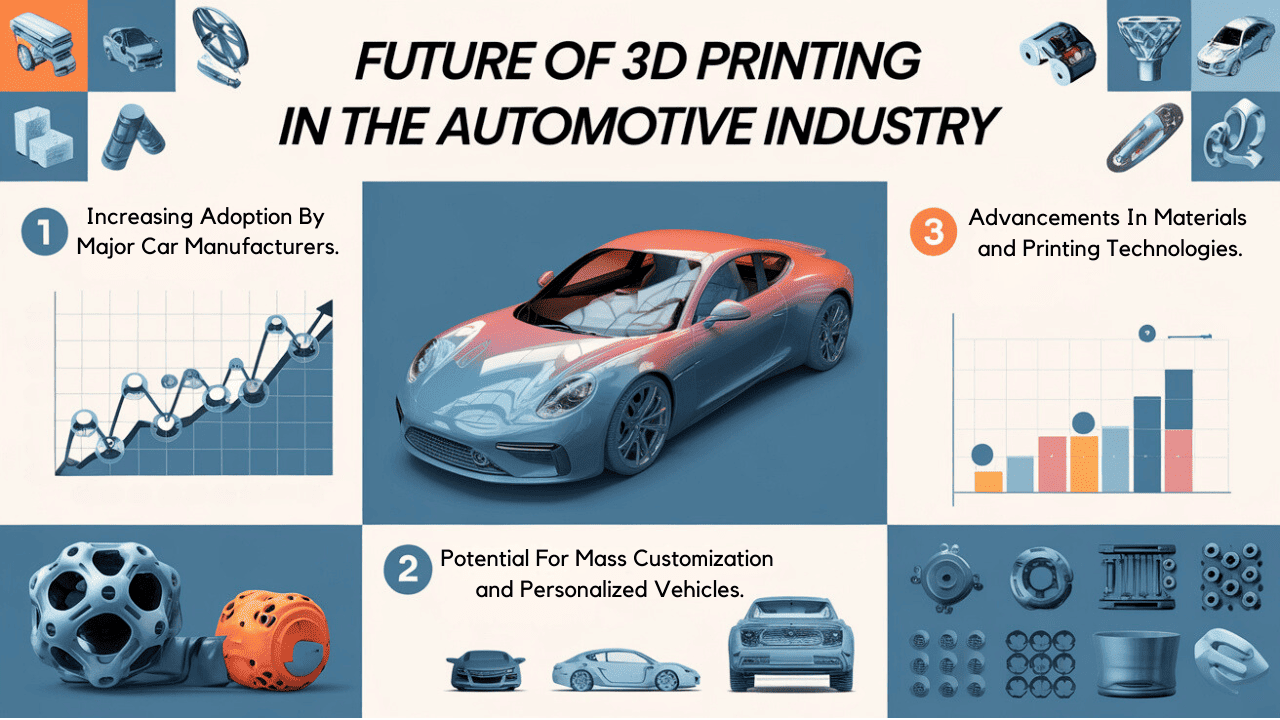
The automotive industry is on the cusp of a revolution, with 3D printing technology poised to transform the way cars are designed, manufactured, sold, and customized. Here are some key trends and predictions for the future of 3D printing in the automotive sector:
- Increasing adoption by major car manufacturers
- Leading automakers like Ford, BMW, and Volkswagen are investing heavily in 3D printing technology for prototyping, tooling, and end-use parts production.
- 3D printing enables faster product development cycles, reducing the time from concept to production.
- Manufacturers can create complex, lightweight parts that are difficult or impossible to produce with traditional methods.
- Potential for mass customization and personalized vehicles
- 3D printing allows for greater design freedom and the ability to create highly personalized parts and accessories.
- Customers may be able to order cars with custom-made interior and exterior elements, tailored to their individual preferences.
- Limited edition and one-off vehicles could become more feasible and cost-effective to produce.
- Advancements in materials and printing technologies
- New materials, such as high-performance polymers and metal alloys, are being developed specifically for automotive applications.
- These materials offer improved strength, durability, and heat resistance, making them suitable for a wider range of car parts.
- Advancements in printing technologies, such as faster print speeds and larger build volumes, will enable the production of larger and more complex automotive components.
The table below outlines the potential impact of 3D printing techniques on various aspects of the automotive industry:
| Aspect | Current State | Future with 3D Printing |
|---|---|---|
| Product Development | Lengthy, costly process | Faster, more iterative, and cost-effective |
| Customization | Limited, expensive | Highly personalized, affordable |
| Inventory Management | Large inventories, slow-moving parts | On-demand production, reduced inventory costs |
| Supply Chain | Complex, global | Simplified, localized |
| Aftermarket Parts | Limited availability, high prices | Readily available, cost-effective |
As 3D printing advanced technology continues to advance and mature, it has the potential to revolutionize the automotive industry, enabling faster innovation, greater customization, and more efficient production processes. Car enthusiasts can look forward to a future where they can create and customize their vehicles like never before, thanks to the power of 3D printing.
3D printing is revolutionizing the automotive industry, There You Have It 3D offering cost-effective, efficient, and highly customizable solutions for car enthusiasts. From exterior body kits to interior accessories, performance upgrades to artistic elements, the possibilities are endless. As advances technology, we can expect increased adoption by major manufacturers, mass customization options, and innovative materials. The future of 3D printing in the automotive sector is bright, promising a world where every car can be a unique, personalized expression of its owner. Embrace the power of 3D printing and start exploring how you can transform your vehicle today!